
Highlights from the 20th International Conference on Advances in Experimental Mechanics
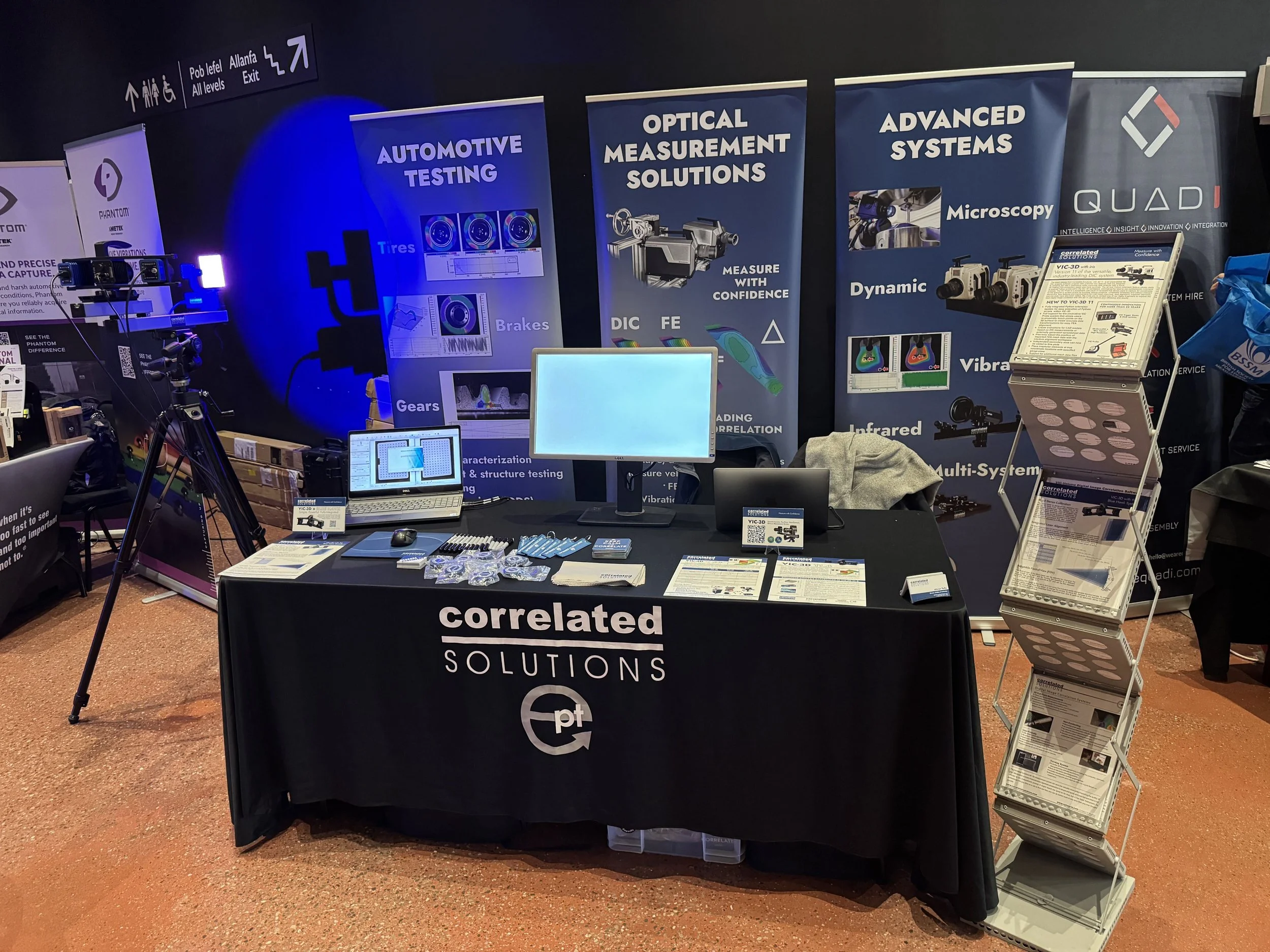
The Correlated Solutions sales and engineering teams recently wrapped up an inspiring week at Swansea Arena in the UK for the 20th International Conference on Advances in Experimental Mechanics, hosted by the British Society for Strain Measurement (BSSM). As the premier UK forum for stress analysis and strain measurement technology, the exhibition offered a fantastic opportunity to connect with researchers, industrialists, and leaders across industries ranging from aerospace and automotive to biomedicine and renewable energy. Throughout the event, our booth was buzzing with activity as attendees stopped by to see our non-contact optical measurement systems—including our industry-standard VIC-3D software and hardware—in action.
This year's Measurements Lecture was given by Michael A. Sutton, Carolina Research Professor in the Department of Mechanical Engineering at the University of South Carolina, and co-founder and Chief Science Officer of Correlated Solutions. The recording is now on our YouTube channel.
The lecture has two parts. The first and larger part presents IMPACT (Inverse Method for Property Assessment via Correlation Techniques), a method that extracts heterogeneous material properties directly from full-field DIC strain data. It solves the equilibrium equations for the properties instead of iterating a finite element model until it matches the measurements. Sutton covers the theory and the stabilization the inverse problem needs, then shows 1D results from synthetic data and from a multi-layer specimen measured with VIC-3D. He also presents new 2D results compared side by side with finite element model updating (FEMU) on an aluminum tensile specimen. The FEMU analysis was run independently by Hubert Schreier and Ian Adkins of Correlated Solutions.
The second part presents a non-parametric method for reconstructing stress fields under dynamic loading. It combines DIC-measured motion with explicit dynamic finite element analysis, so it needs no material model, and is demonstrated on a Kolsky bar test. The lecture closes with a short history of DIC.
Beyond the technical presentations, our team loved engaging directly with attendees to discuss real-world testing challenges and explore how high-accuracy, non-contact DIC technology can streamline their research workflows. We want to thank everyone who visited our stand, asked insightful questions, and shared their project goals with us. If you missed us in Swansea or would like to discuss how Correlated Solutions can support your specific strain measurement requirements, feel free to reach out to our sales and technical support team—we’d love to keep the conversation going!