
Every DIC measurement starts from a reference image: the surface before anything has happened to it. On a test specimen, that picture is easy to take. A concrete wall that is still being printed doesn't have one. When the first layer goes down, the layers above it don't exist yet.
A team at Rowan University, led by Islam Mantawy and Behrad Koohbor, turned the analysis around. They captured thousands of images while the concrete was printed and cured. Then they started from the images of the finished structure and worked backward. The pattern they tracked is the concrete's own surface roughness, not an applied speckle pattern.
The early hours are when it matters. Each lower layer carries the weight of everything placed on it while it is still curing. If the bottom layer cracks, the whole structure can fail before it's finished. A measurement that follows the wall as it is built is a way to catch that. The idea looks obvious once someone has done it. The work is in showing it holds up, and the paper builds a mathematical approach to validate the reverse-time method.
“Reverse-time DIC enables tracking the strain and deformation evolution during concrete additive manufacturing process revealing for the first time the hidden mechanics of concrete 3D-printed structures”
“Reverse-time DIC creates a framework for direct experimental monitoring of in-process deformation fields, with strong potential for application in additive manufacturing and other scenarios where conventional DIC may be limited.”
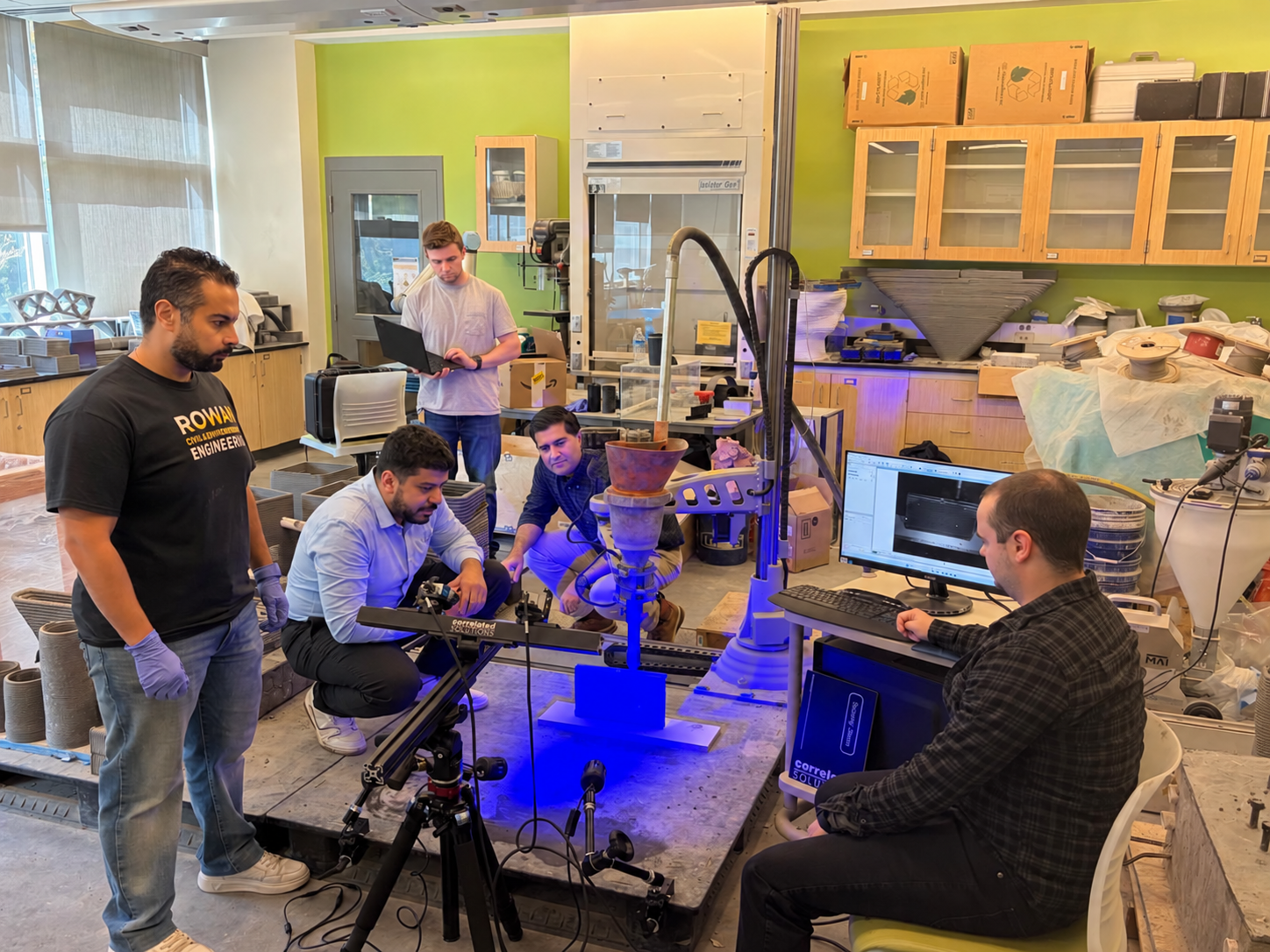
Mantawy/Koohbor research groups
The team made the measurements with image correlation software from Correlated Solutions, and it has had our support team talking since it came out. We’re excited to see what comes next. Congratulations to Nicholas Pagliocca, Anthony Mackin, Aly Ahmed, Jenna Migliorino, Islam Mantawy, and Behrad Koohbor.

The paper, Digital Image Correlation in Reverse Time: A Case Study of In-Process Metrology During Concrete Additive Manufacturing, is in Experimental Mechanics (doi.org/10.1007/s11340-026-01381-4).
Rowan's release has more details, and Rowan's video Building the Future of Civil Engineering visits Mantawy's lab and gives some useful background on their technique.