When a DIC measurement and a finite element model disagree, the model usually gets the blame first. Often the cause is in the set-up. A Best Plane-Fit option left on during registration silently corrupts the alignment. A Z-axis pointing the opposite way flips the sign of the out-of-plane displacement. Each produces a difference that looks like a modeling error and isn't one.
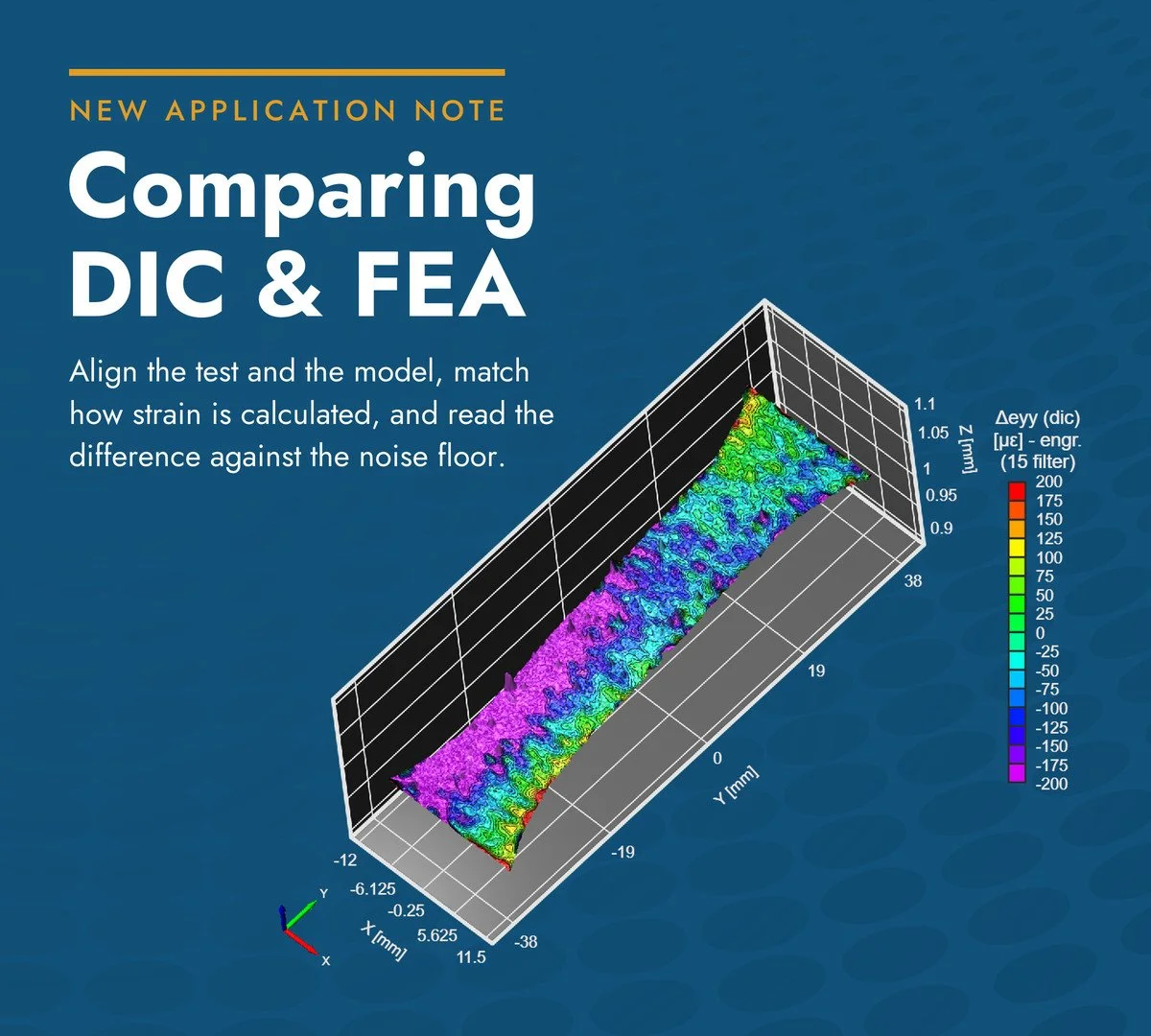
Our new application note, Comparing DIC & FEA, sets out the VIC-3D 11 workflow for a quantitative comparison with results from Abaqus or Ansys, for validation or model updating. It covers aligning the DIC and FE coordinate frames, matching each DIC frame to the right load state, and matching the strain tensor, strain frame, and smoothing on both sides. The comparison runs in the Compare DIC and FE extension, which interpolates FE displacements onto the DIC grid and recomputes FE and DIC strain with the same filter and tensor, so the residual reflects the model and not differences in how strain was calculated.
The note also covers measuring the noise floor before reading any result. A difference smaller than the noise in the measurement itself can't be told apart from that noise. It shows how to measure the noise floor with the Noise floor extension, and asks you to report the multiple of the noise floor you treat as a real difference.